Jim KnightWidely regarded as the founding father of instructional coaching.
Jim Knight’s instructional coaching research began in 1996. 30 years on, over 150,000 instructional coaches have been trained through him and the Instructional Coaching Group, and his organization is part of engage2learn.
One line of work, from where it began to where it is now.
The ideas a coach now takes for granted (how to partner with a teacher, how a coaching cycle runs, what a coaching program needs) came out of one long body of research. Scroll down the line.
- 1996
The research begins.
Jim Knight’s instructional coaching research begins, learning alongside coaches, teachers and school leaders.
- The work
The partnership principles.
Coaches and teachers work as equals: equality, choice, voice, dialogue, reflection, praxis and reciprocity.
-
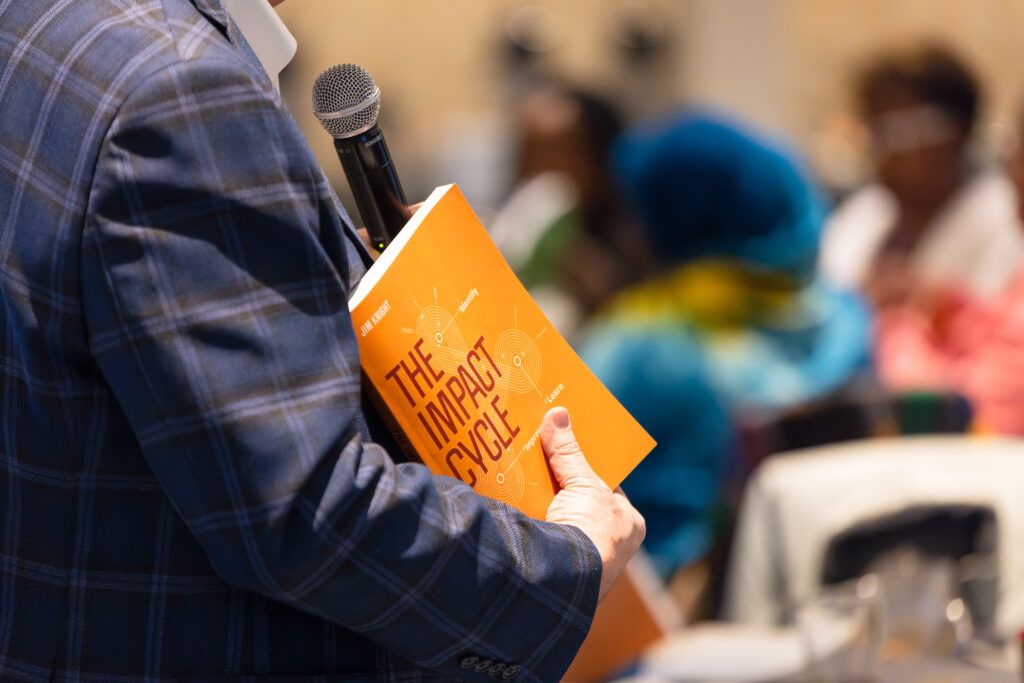
The Impact Cycle.
A coaching cycle a coach and teacher can run together: Identify a clear picture of reality, a goal and a strategy, then Learn and Improve.
-
The seven success factors.
Research with over 150,000 instructional coaches, distilled into what a coaching program needs: partnership, communication, leadership, the coaching process, data, the instructional playbook and system support.
- 30 years
Over 150,000 coaches trained, and part of engage2learn.
Over 150,000 instructional coaches have been trained through Jim Knight and the Instructional Coaching Group. The Instructional Coaching Group, Jim Knight’s organization, is part of engage2learn.
Coaching as a partnership between equals.
The principles sit under everything else in Jim Knight’s work. A coach who holds them works with a teacher, never on one.
- Equality
- Choice
- Voice
- Dialogue
- Reflection
- Praxis
- Reciprocity
Seven principles, held together: the coach and teacher are equals, the teacher chooses, and both learn.
Jim Knight’s work, in your district.
Tell us about your coaches and your leaders, and we’ll show you where his work would start for you.