
Why districts need guardrails, not bans, when teachers use AI
District leaders find themselves in a familiar position: the reality in classrooms is moving faster than policy, training, and systems can keep up. That is especially true with the use of AI as a teaching aid.
Teachers are already using AI. Most are doing it to survive the crushing pace of planning, differentiation, parent communication, and classroom management. In a year that is already full, the path of least resistance is to open the nearest AI tool and ask it to “generate workable content.”
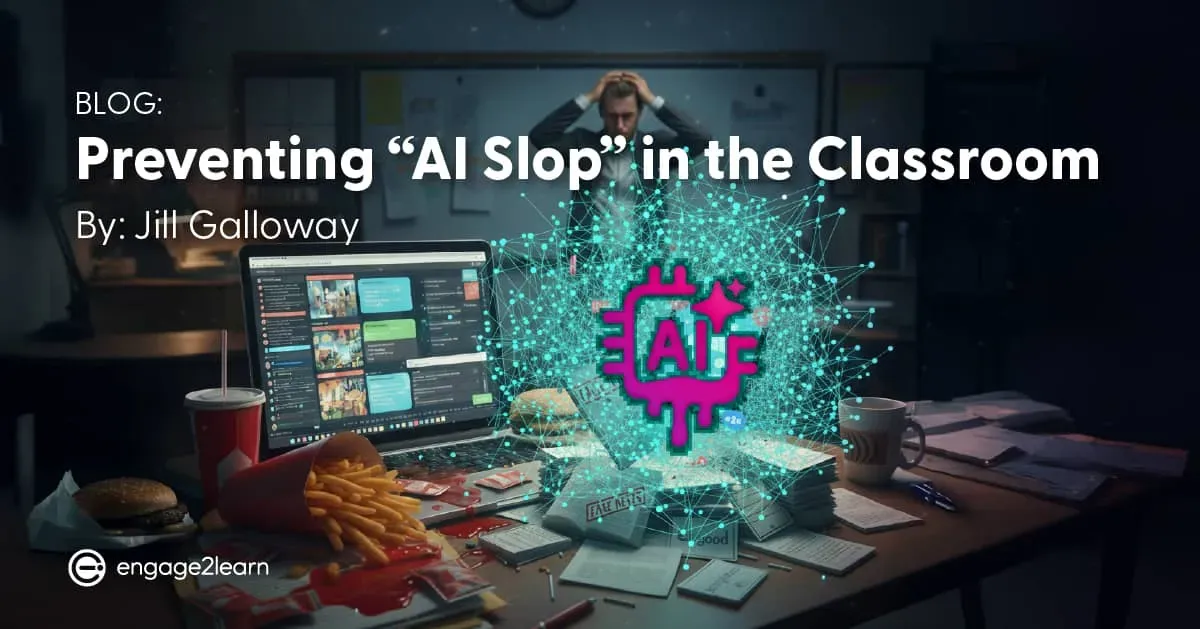
This is where “AI slop” begins.
Teachers care. The trouble is that the system hasn’t given them a safe, consistent, and district-aligned framework for using AI.
What “AI Slop” Actually Is (and Why It Spreads)
Think of “AI slop” as the instructional equivalent of fast food: quick, convenient, and often acceptable on the surface. However, it is inconsistent, difficult to verify, and rarely built for or aligned to your district’s specific context.
In practice, it shows up as:
- Misaligned Lesson Plans: Content that sounds polished but fails to align with your pacing, standards, adopted resources, or local expectations.
- Generic Differentiation: Suggestions like “provide sentence stems” or “use small groups” that ignore what specific students need.
- Fabricated Facts: Shaky examples or hallucinations that force teachers to double-check every output, negating the time savings.
- Unrealistic Management Advice: Platitudes like “set clear expectations” without concrete steps for transitions, routines, or behavioral supports.
None of this is malicious. It comes from using tools optimized for “fast text output” as default instructional assistants. However, once a few teachers start using them, the practice spreads because it looks like time saved.
The Bigger Risk: Uneven Quality at Scale
If teachers are using a dozen different AI tools across a district, the result is more than “some AI use.” It is:
- Wide variance in instructional quality.
- Inconsistent alignment to district priorities.
- Increased burden on coaches and principals to correct and re-center instruction.
- Instructional fragmentation, where “what’s being taught” is shaped by whoever prompts the best and whichever model is most persuasive that day.
This is a system problem. District leaders do not need to police teachers, but they do need to protect them from an impossible position: being expected to personalize instruction and manage behavior while simultaneously functioning as the quality-control department for unvetted AI.
So the question for districts is how to give teachers the benefit of AI without sacrificing quality, coherence, and trust.
What Districts Need: Guided AI Inside a Professional System
Districts that handle this well treat AI like any other instructional resource. This means AI use is embedded within professional support systems and trained with district guidance, rather than layering it on top as a productivity hack. It should be:
- Vetted
- Aligned
- Guided
- Supported
That is what separates “AI that generates content” from “AI that supports instruction responsibly and is backed by research-based best practices.”
A Safer Alternative: GroweLab AI
What this looks like in practice is a guided AI environment that is trained on vetted, district-aligned resources and embedded within professional learning and coaching structures. GroweLab’s approach is built for this district reality: teachers move faster, while leaders maintain consistency and instructional integrity.
Inside GroweLab, educators access AI support trained on engage2learn’s curated library of resources, templates, and research materials instead of a mixed bag of unknown internet sources. It is built as a thought partner rooted in educator practice rather than a generic “answer machine.”
When AI isn’t enough (when judgment, context, or sensitivity is required), GroweLab pairs that support with live access to expert engage2learn coaches. This combination gives schools what they need:
- Just-in-time help.
- Aligned, expert guidance.
- A human backstop when things get complex.
Classroom management shows what preventing “AI slop” looks like day to day.
When a teacher is struggling with classroom management (transitions running long, attention slipping), generic AI produces generic advice. It sounds correct but doesn’t solve the problem.
With GroweLab’s educator-guided support, teachers can use AI (and coaches) as a practical partner to:
- Troubleshoot specific routines and transitions.
- Draft age-appropriate behavior expectations and re-teach plans.
- Build proactive strategies (entry routines, station rotation norms).
- Design engagement structures that reduce off-task behavior.
The goal is to drastically reduce the time it takes to arrive at a strategy that fits the classroom, with the teacher’s skill still doing the deciding.
A Simple Path Forward: Guardrails, Not Gotchas
If you want to prevent AI slop without adding a heavy administrative initiative, start with three practical moves:
01. Name the constraint out loud. Acknowledge that teachers are using AI because time is a scarce resource. Set the tone that your goal is support, not surveillance.
02. Set guardrails, not gotchas. Define what “responsible AI use” means in your district. It should:
- Align to standards, pacing, and approved resources.
- Protect student privacy.
- Require verification of facts and examples.
- Keep teacher judgment central (use AI to draft, not to decide).
03. Provide a district-ready option. The fastest way to reduce risky, inconsistent AI use is to give teachers a trusted default: a guided AI environment built for education and backed by professionals.
Where This Leaves District Leaders
Preventing AI slop means keeping instruction coherent as AI becomes part of daily practice, without shutting down innovation. Without guardrails, inconsistent instruction becomes harder to coach. A guided system accelerates teacher growth while protecting quality, alignment, and trust.
What teachers need is better support, the kind that saves time and holds the line on quality, more than they need “more AI.” If AI is going to be part of instruction in your district, it must be guided by educators, aligned to your priorities, and backed by human expertise.
Then AI can give districts clarity, follow-through, and momentum without adding more work.
First published February 3, 2026, by Jill Galloway.